
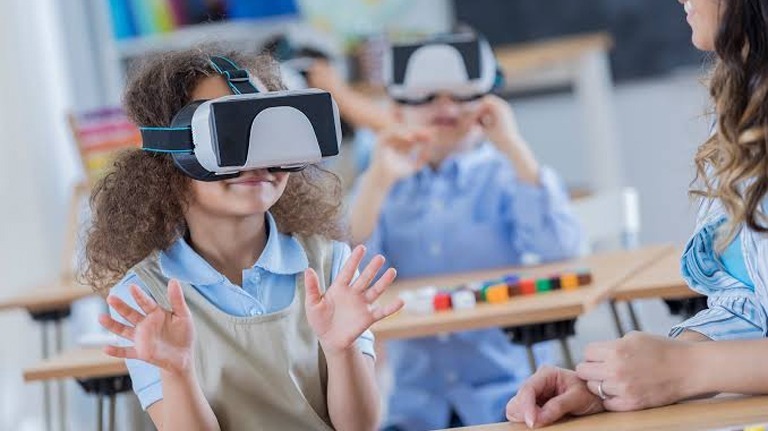
Traditional classroom training can become repetitive and challenging to engage with in today’s rapidly evolving educational environment. As learning methods continue to change, educators need innovative approaches that capture students’ attention and create more meaningful learning experiences.
For generations, classrooms have relied on textbooks, lectures, and whiteboards. While these traditional methods remain valuable, they can struggle to maintain students’ interest in an era where learners are increasingly drawn to interactive, visual, and hands-on experiences.
Virtual Reality (VR) is transforming this learning experience-not by replacing teachers, but by empowering them with an innovative tool that brings lessons to life. By creating immersive and interactive environments, VR can make learning more engaging, memorable, and impactful for students.
At XR Horizon, we work with schools, training institutes, and enterprises to build VR experiences that turn passive learning into active exploration. Here’s how VR is reshaping the way people learn.
- Learning by Doing, Not Just Watching
One of the biggest limitations of conventional education is that students often learn about something without ever experiencing it. VR flips this by placing learners directly inside the subject matter.
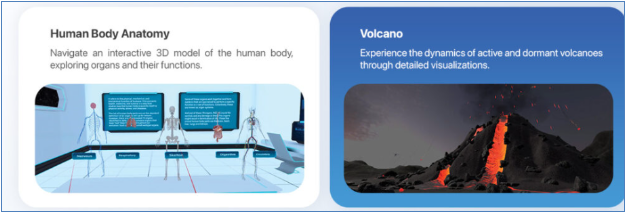
A biology student can walk through a beating human heart instead of looking at a diagram. A trainee mechanic can disassemble a virtual engine as many times as needed without any real-world cost or risk. This kind of experiential learning helps concepts stick far longer than passive reading or listening.
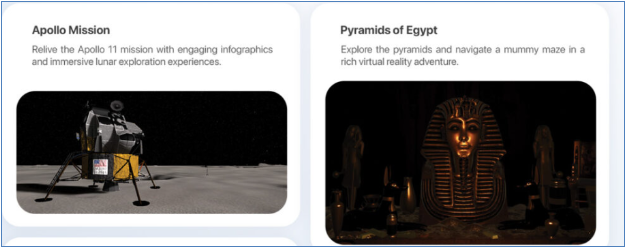
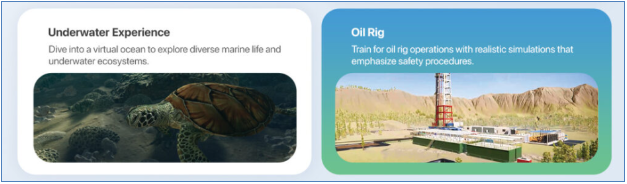
Here’re some of our innovative learning project
Safe Practice for High-Risk or High-Cost Scenarios
Some skills are simply too dangerous, expensive, or logistically difficult to practice in real life, think surgical procedures, industrial machinery operation, firefighting, or aviation training. VR removes these barriers entirely.
Learners can make mistakes, restart scenarios, and repeat procedures as many times as necessary, all in a completely safe, zero-cost, zero-risk environment. This freedom to fail and try again is one of the most powerful pedagogical advantages VR offers.
Learning at Every Student’s Own Pace
Every classroom has a mix of students who grasp a concept instantly and others who need more time. VR-based learning allows each student to explore at their own speed, revisit difficult sections, and receive instant feedback — something a single teacher managing thirty students often can’t provide in real time.
This self-paced, personalized approach helps close the gap between fast and slow learners without anyone being left behind or held back.
Bringing History and Geography to Life
Some of our most popular ExarED experiences take students on journeys they could never take in a regular classroom — exploring the Pyramids of Egypt and navigating a mummy’s maze, or taking a 360° tour of major dams in Kerala, including a 3D walkthrough of the otherwise inaccessible interior gallery of the Malampuzha and Neyyar Dams, complete with engineering infographics.
These aren’t just novelties — they connect theoretical classroom knowledge to real-world structures and events, making the learning stick long after the headset comes off.
At XR Horizon, we’re building ExarED specifically so teachers don’t need technical expertise to bring immersive content into their classrooms — the content is designed to slot directly into existing curricula, not replace how teachers already teach.
Want to see how a specific lesson could work in VR? Get in touch with XR Horizon or download the ExarED brochure to explore what’s available.
